Bimini Twist Knot: How to Tie One & When to Use It
When a fish makes a hard run, the last thing you want to wonder about is whether your knot is going to hold.
That’s especially true offshore, where powerful fish, heavy tackle, long runs, and abrasive conditions can put tremendous stress on every connection between the angler and the fish. A well-tied knot can be one of the strongest parts of that system. A poorly tied one can become the weakest link.
The Bimini Twist has earned its reputation as a go-to double-line knot for anglers who want to build a strong connection at the business end of their main line. Rather than simply connecting line to a hook or lure, the Bimini Twist creates a doubled section of line that can then be connected to a leader or other terminal setup.
It takes some practice to tie, but once you understand what the knot is doing—and why anglers use it—the process becomes much easier to master.
Here’s how to tie a Bimini Twist, when to use one, how it fits into a larger fishing system, and the mistakes to avoid when tying it.
What Is a Bimini Twist Knot?
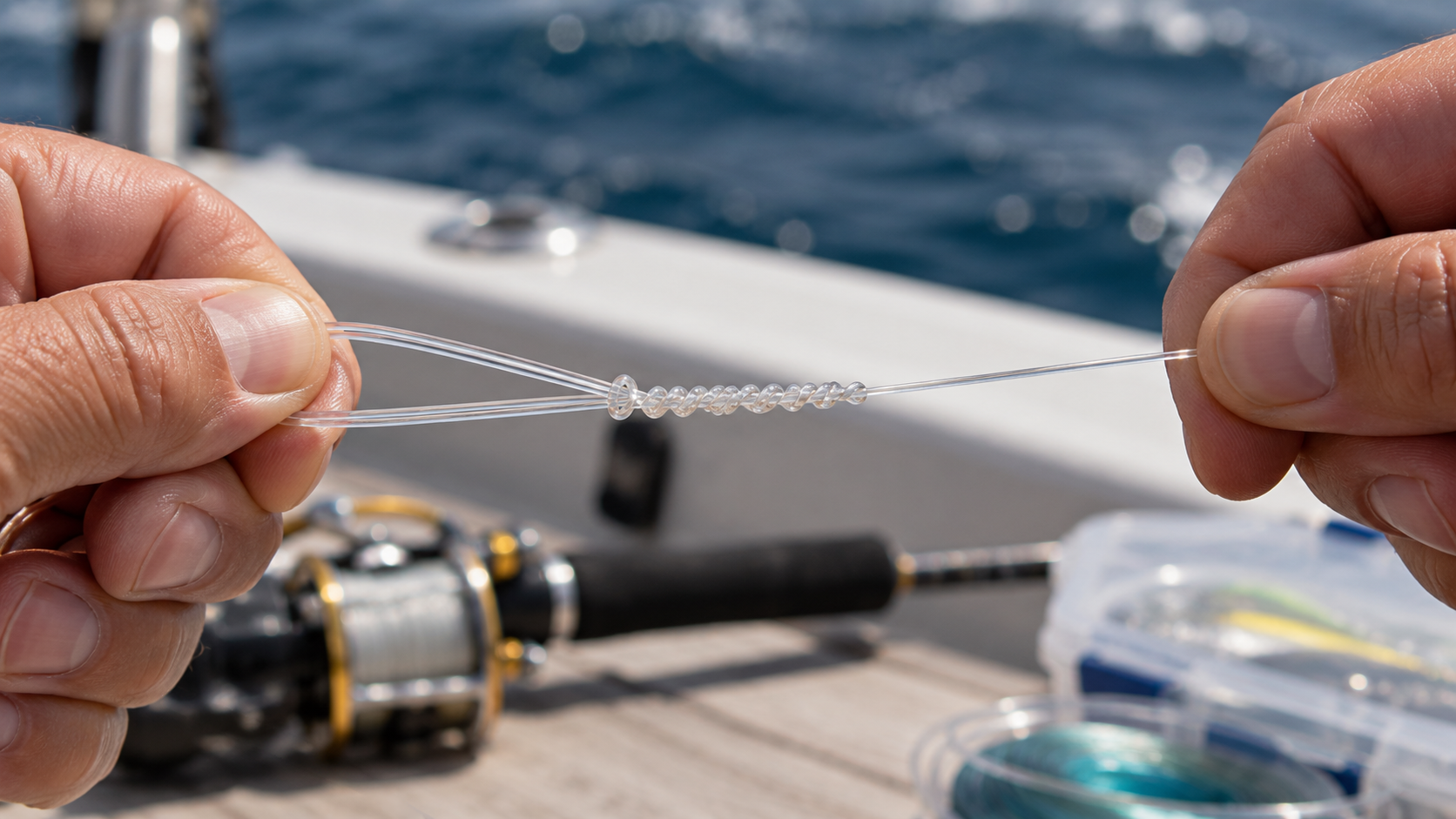
The Bimini Twist is a double-line knot designed to create a strong loop at the end of your main line.
Instead of tying directly from a single strand of fishing line to your leader or terminal tackle, the knot doubles back a section of the main line and twists the two strands together. The finished knot leaves you with a loop and a doubled section of line that can be used as the foundation for another connection.
That makes the Bimini Twist different from many of the basic fishing knots anglers learn first. A Palomar, improved clinch, or Uni knot is generally used to attach line directly to a hook, lure, swivel, or other terminal connection. The Bimini Twist serves a different purpose: it creates the double line first.
That extra step can be especially useful when you’re building tackle for strong fish that can put serious pressure on the connection.
Why Anglers Use a Bimini Twist
The primary reason to tie a Bimini Twist is strength.
A properly tied Bimini can preserve a very high percentage of the original line strength, which is one reason the knot has long been popular in offshore and big-game fishing. Testing has shown that well-tied Bimini Twists can perform exceptionally well in both monofilament and braided line, although results can vary depending on the line, tying technique, and finishing method.
The doubled section also gives anglers a useful connection point for building leader systems. Instead of asking one strand of line to handle every part of the fight, the Bimini creates a doubled section that can be connected to heavier leader material or another part of the rig.
There’s another practical advantage: a properly finished Bimini can create a relatively streamlined double-line connection that is capable of passing through rod guides when the setup is built correctly.
In other words, the Bimini Twist isn't simply about tying a complicated knot because experienced anglers like complicated knots. It has a job to do.
When Should You Use a Bimini Twist?
The Bimini Twist makes the most sense when the fishing situation demands more from your tackle than a basic terminal knot.
Offshore & Big-Game Fishing
The Bimini Twist is particularly associated with offshore fishing, where anglers may be targeting species capable of making long, powerful runs and putting heavy pressure on the line.
Tuna, billfish, wahoo, tarpon, and other hard-fighting species are examples of situations where anglers may choose to build a double-line system before connecting to a leader.
The knot also has a long history among serious saltwater anglers because it provides a strong foundation for more elaborate terminal tackle. When you’re preparing for a fish that can turn a peaceful day offshore into a full-on tackle test, every connection deserves attention.
Building a Double-Line Connection
One of the biggest advantages of the Bimini Twist is that it doesn't have to be the final knot in your setup.
Think of it as the first step in building a connection.
The finished loop can be used with other knots and connection methods to attach your main line to heavier leader material. This approach is common in offshore and inshore applications where anglers want the strength and flexibility of a doubled main line before transitioning to a leader.
That means the Bimini Twist can be part of a complete system rather than the entire system itself. A strong Bimini connected to a poorly tied leader knot doesn't create a strong fishing rig. The entire connection is only as dependable as its weakest link.
Mono, Fluorocarbon & Braid
The Bimini Twist can be tied with different types of fishing line, including monofilament and braided line, but that doesn't mean every version should be approached exactly the same way.
Line diameter, stiffness, flexibility, and surface characteristics can all affect how the twists form and how the finished knot behaves. Braid, in particular, can require more attention to maintaining tension and properly securing the finished knot.
That's why practice matters.
If you're planning to use a Bimini Twist with a particular line, practice with that same line before you head offshore. A knot that looks perfect in a different diameter or construction may behave differently when you switch tackle.
The goal isn't simply to memorize a sequence of movements. It's to learn what a properly formed Bimini Twist looks and feels like in the line you're actually going to fish.
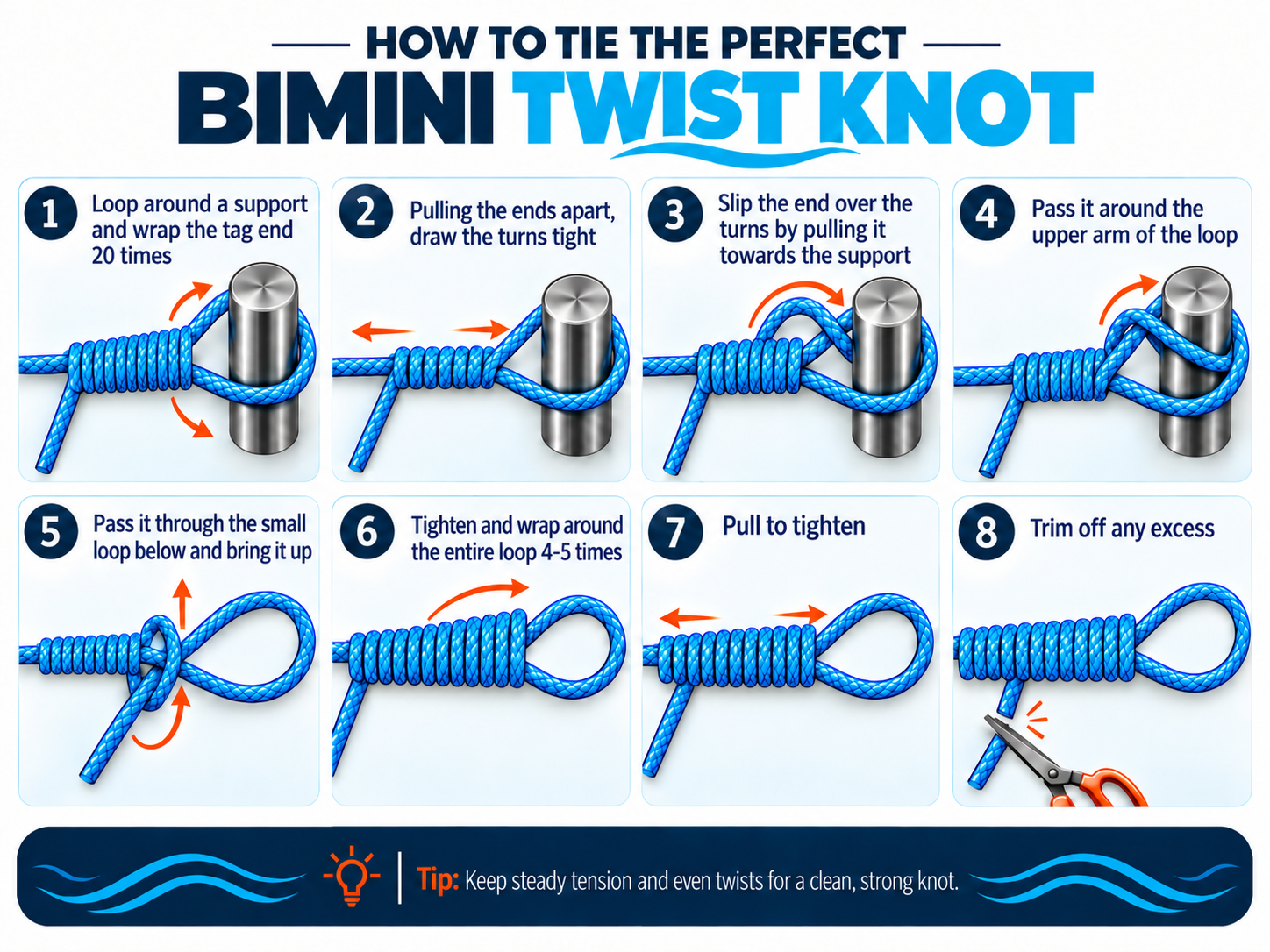
How to Tie a Bimini Twist Knot
The Bimini Twist can look intimidating the first few times you tie one. Once you understand the basic sequence, however, it becomes much less mysterious.
The key throughout the process is tension. The twists need to form cleanly, and the knot needs to be finished securely without allowing the structure to loosen.
Take your time the first several times you practice. Speed comes later.
Step 1: Double the Line
- Start by doubling the section of main line you want to turn into your Bimini Twist.
- Create a large loop and hold the two strands together. You’ll need enough working line to form the twists and complete the finishing hitches, so don't start with an unnecessarily short section.
- For the traditional method, anglers commonly begin with approximately 20 twists.
- Place the loop around a fixed point—or use your knee or another stable point to help maintain tension—and keep steady pressure on the line.
The important part isn't simply making the twists. It's keeping everything under control while you make them.
Step 2: Create the Twists
- With the loop secured and tension maintained, begin twisting the doubled section.
- The two strands should form a consistent column of twists rather than a loose, uneven tangle. Keep the tension steady as you work.
- This is where beginners often rush. Don't.
- If the twists are loose or inconsistent, the finished knot won't have the clean structure you're looking for. Slow, controlled movements are much more useful than trying to tie the knot quickly.
As you gain experience, you'll develop a feel for how much tension to maintain and how the line should respond as the twists form.
Step 3: Compress the Twists
- Once the twists are formed, slowly spread the two strands of the loop apart. This causes the twists to compact and move down the line toward the fixed point.
- As the twisted section compresses, allow the tag end to roll back over the column of twists. This is one of the most important parts of the entire process because it transforms the loose twists into the compact structure that becomes the finished Bimini.
- Keep the tension steady and let the line do the work rather than forcing the twists into place.
You’re looking for a neat, compact series of wraps—not crossed strands, loose coils, or a tangled mass.
Step 4: Lock the Twists in Place
- Once the tag end has rolled down the twisted section, make a half hitch on the near side of the loop. This locks the twists in place while you continue maintaining tension on the line.
- At this stage, the knot should begin to look much more recognizable. The important thing is not to relax your grip just because the knot is starting to take shape.
The finishing process is what secures everything you've created so far.
Step 5: Finish the Bimini Twist
- Continue securing the knot with additional half hitches around both strands of the loop.
- Work back toward the knot, keeping the wraps neat and tightening them carefully. Once the finishing hitches are secure, pull the tag end to snug everything down.
- Finally, trim the tag end, leaving enough material to avoid accidentally cutting into the finished knot.
- Take a moment to inspect it before putting it to work.
A properly tied Bimini Twist should have a clean, compact twisted section with secure finishing hitches and a clearly defined loop. If the wraps are loose, crossed, uneven, or visibly sloppy, cut it off and tie another.
That's far easier to do at the dock than after a big fish has already taken the bait.

How to Connect a Bimini Twist to Your Leader
Tying the Bimini Twist is only part of the process. In many fishing applications, the finished double-line loop becomes the starting point for connecting your main line to a heavier leader. That’s where the Bimini really earns its place in an offshore tackle system.
The exact connection you choose depends on your line, leader material, target species, and fishing style, but the basic principle remains the same: the Bimini creates the strong double-line foundation, and another connection method joins that foundation to your leader.
Loop-to-Loop Connections
One of the simplest ways to use the finished Bimini loop is with a loop-to-loop connection.
A loop-to-loop connection allows you to attach a pre-tied leader to the doubled section of your main line without cutting and retying the Bimini every time you change leaders. This can be particularly useful when you prepare multiple leaders before leaving the dock.
The key is making sure both loops are properly formed and securely connected. A clean connection should sit neatly without unnecessary bulk or loose sections that can catch on guides or other equipment.
For anglers who frequently switch leaders, having several pre-tied options ready to go can save valuable time on the water.
Bimini Twist + Leader Connection Knots
The Bimini Twist can also be paired with another knot designed to connect the doubled main line to a leader. Depending on the tackle system, anglers may use connections such as a Bristol, No-Name, or Yucatan knot to complete the transition from the Bimini's double line to the leader.
These knots serve different purposes and have their own tying techniques, so it's worth learning the specific connection that best matches your setup rather than assuming one method works for every application.
The important takeaway is that the Bimini Twist doesn't have to stand alone. Think of it as one component of a larger system designed to move the load from your main line to your leader as efficiently as possible.
Why the Connection Matters
A beautifully tied Bimini Twist can't compensate for a weak leader connection.
Every part of the tackle system matters—from the main line and Bimini to the leader, terminal connection, hook, lure, and even the condition of the line itself. That means your preparation should go beyond asking, "Did I tie the Bimini correctly?"
Ask whether the entire system is ready for the fish you're targeting. If you're preparing for a powerful offshore species, inspect the leader for abrasion, check your terminal connections, and replace anything that looks questionable before you start fishing.
The strongest knot in the rig doesn't matter if the connection immediately above it fails.
Common Bimini Twist Mistakes
The Bimini Twist isn't necessarily difficult, but it is less forgiving than some of the basic knots anglers learn early in their fishing lives. Most problems come down to rushing the process or failing to maintain consistent tension. Here are some of the mistakes worth watching for:
- Losing tension while tying: Loose twists can create an uneven or poorly formed knot.
- Making inconsistent twists: Keep the twists controlled and reasonably uniform rather than creating a loose or tangled section.
- Rushing the finishing hitches: The finishing process is what locks the twisted section in place. Give it the attention it deserves.
- Cutting the tag end too short: Leave enough material for a secure finish and trim only after the knot is fully tightened.
- Ignoring line differences: Mono and braid can behave differently. Practice with the actual line you're planning to fish.
- Failing to inspect the finished knot: Look for loose wraps, crossed strands, damaged line, or an uneven structure before putting it into service.
- Tying it for the first time on the boat: This one sounds obvious, but it’s surprisingly common to wait until a knot is needed before trying to learn it. Practice at home first so you can tie it confidently when it counts.
That last point may be the most important. The middle of a calm afternoon at the dock is a much better time to learn the Bimini Twist than the moment after a trophy fish has already taken your bait.
Bimini Twist vs. Other Fishing Knots
One reason the Bimini Twist can be confusing for newer anglers is that it isn't really competing with many of the familiar fishing knots. It has a different job.
Knot Type Primary Purpose
Bimini Twist Creates a strong doubled-line loop
FG Knot Connects braided main line to a leader
Palomar Knot Attaches line to hooks, lures, and terminal tackle
Uni Knot Versatile connection for line, hooks, swivels, and other terminal tackle
The Bimini Twist is therefore better thought of as a building block than an all-purpose fishing knot.
For example, an angler might create a Bimini Twist in the main line and then use another connection method to attach that doubled line to a leader. Another angler may have a completely different terminal setup.
There isn't one knot that automatically makes every fishing system stronger. The goal is to understand what each knot is designed to do and build your tackle accordingly.
Bimini Twist Tips for Offshore Anglers
Once you understand the knot, a little preparation can make it much easier to use in the real world.
Tie It Before You Leave the Dock
If you know you're going after powerful fish, don't wait until you're offshore to build your primary connections. Tie and inspect your Bimini Twists ahead of time when you have good lighting, a comfortable workspace, and no fish waiting for you.
Practice With Your Actual Line
The best way to learn the Bimini Twist is to practice with the line you actually intend to fish. Different line types and diameters can behave differently during the twisting and finishing process. Learning those characteristics before you're on the water will make the knot much easier to reproduce consistently.
Carry Pre-Tied Leaders
If you're using the Bimini as part of a leader system, consider preparing several leaders before your trip. A pre-tied leader can turn what might otherwise be a lengthy repair into a relatively quick tackle change, getting you back to fishing instead of spending half the day rebuilding your rig.
Inspect After a Hard Fight
Even a properly tied knot deserves another look after a demanding battle. Check the doubled line, finishing hitches, leader connection, and leader itself for abrasion or damage. If anything looks questionable, retie it. Five minutes of preparation is a much better investment than losing a fish because you hoped the connection was still good.
Don't Confuse Complexity With Strength
A Bimini Twist is more involved than many basic fishing knots, but that doesn't automatically make it the right knot for every situation. Use it when its strengths match the fishing you're doing. For light tackle and simple terminal connections, a more straightforward knot may be all you need. For demanding applications where a strong double-line connection is useful, the Bimini Twist can become a valuable addition to your knot repertoire.
The best knot isn't necessarily the most complicated one. It's the one that fits the job—and that you can tie correctly.
Final Thoughts
The Bimini Twist has earned its place in the tackle boxes of serious anglers because it solves a very specific problem: creating a strong, doubled section of fishing line that can serve as the foundation for a leader connection.
It's not the quickest knot to learn, and it may take several attempts before the twists and finishing hitches feel natural. But that's exactly why practicing it before you need it matters. Learn the motion. Understand what the finished knot should look like. Practice with the line you actually fish. Then build the rest of your tackle system with the same attention to detail.
Because when the fish of a lifetime shows up, the time to wonder about your knot is already gone.
For more fishing tips, boating resources, and equipment for your next day on the water, visit Unreel Marine.

